Brighton Snow Report
Big Cottonwood Canyon · 8,790 ft · Utah
SNOTEL Station 366 · Updated
Brighton Current Snow Conditions
Current Conditions
Snow Depth
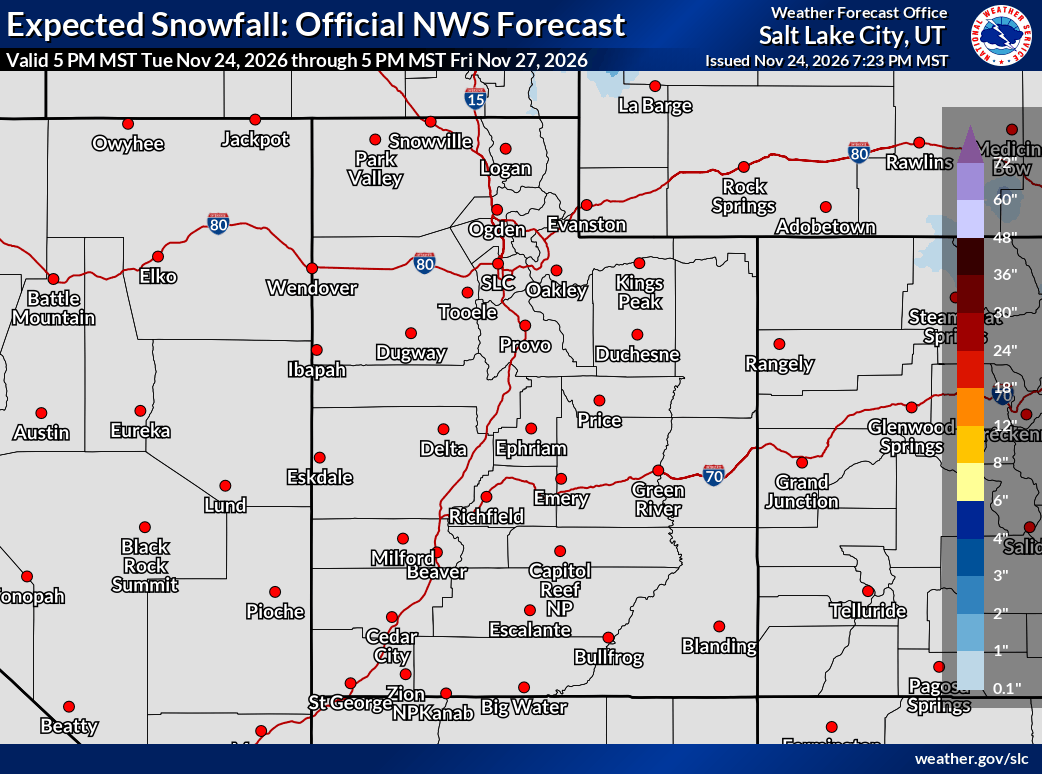
NWS Snow Forecast
Base — 5-Day Forecast
Solitude Ski Area · 8,146 ft · Open-MeteoBase — Wind
Solitude Ski Area · 8,146 ft · 48-hour past & forecastMid-Mountain — 5-Day Forecast
Brighton · 8,790 ft · Open-MeteoMid-Mountain — Wind
Brighton · 8,790 ft · 48-hour past & forecastSummit — 5-Day Forecast
Clayton Peak · 10,721 ft · Open-MeteoSummit — Wind
Clayton Peak · 10,721 ft · 48-hour past & forecastWind roses show how often wind blows from each direction. Longer petals mean wind came from that direction more frequently. Color shows speed: blue is calm, darker blue is moderate, red is strong.
The timeline arrows point in the direction the wind is blowing toward — the way snow would drift. If you face the direction the arrow points, the wind is at your back.
For skiing: Wind-loaded slopes (leeward side) accumulate deeper but less stable snow. The rose helps identify which aspects have been wind-affected and which will be affected next.
Speed guide: Under 15 mph is comfortable on a chairlift. 15–30 mph causes exposed lifts to slow or hold. 30+ mph typically means upper lift closures and dangerous ridgeline conditions.
Webcams
About Brighton
Snow depth at Brighton is measured daily by SNOTEL station #366, located at Brighton, Big Cottonwood Canyon, Salt Lake County, Utah at an elevation of 8,790 ft. This automated sensor is operated by the Natural Resources Conservation Service (NRCS) and has been recording continuous snowpack data since 1997.
This page provides current snow depth, snow water equivalent (SWE), 24-, 48-, and 72-hour new snowfall totals, snow density and quality analysis, and historical season rankings spanning 29+ years of records. Snowpack is ranked against every prior season on record, showing where the current winter stands historically for Brighton.
The 5-day weather forecast uses Open-Meteo data at three elevation zones: Solitude Ski Area (8,146 ft), Brighton (8,790 ft), Clayton Peak (10,721 ft). Wind speed, direction, and gust data are shown for both the past 48 hours and the next 48 hours at each elevation, with interactive wind rose visualizations.
Following the Northwest River Forecast Center’s (NWRFC) discontinuation of snow depth and snow density graphs in June 2025, Cascade Snow provides a free, daily-updated alternative with interactive historical charts and comprehensive snowpack analysis for Utah’s mountains. All data is sourced directly from Natural Resources Conservation Service (NRCS) sensors and updated automatically each morning.
Brighton snow questions
How much snow is at Brighton right now?
The SNOTEL at the head of Big Cottonwood read 15″ on the ground on Nov 24, carrying 3.2″ of water. That is one sensor in a clearing at 8,790 ft near the top of the canyon — the ridges above Catherine Pass and Clayton Peak hold considerably more, and the lower canyon considerably less, so read it as the canyon's baseline rather than as what you will find at 10,000 ft.
Is the Wasatch snowpack above or below normal?
Across this station's depth record the median for today's date is 11″, and the current reading ranks 8 of 30 seasons on the same calendar date. The depth sensor went in during 1997, eleven years after the station itself, so the ranking is read against 30 seasons of depth — the water-equivalent record runs longer, which is why percent-of-median figures quoted elsewhere for this station may be drawn from a different span.
When does Big Cottonwood usually reach its deepest snow?
The Wasatch builds through midwinter and typically tops out in late March or early April, later than a maritime Cascade station and earlier than the high Colorado stations. This season's deepest reading so far came on Nov 21; the season chart on this page draws every winter on record against the current one, which is the quickest way to see whether a slow start has recovered.
What are the winter parking and road rules in Big Cottonwood?
SR-190 is open through the winter to the Brighton loop, but the rules above the Willow Heights trailhead are worth reading before you drive up: UDOT bans parking in the designated avalanche zones from 1 November to 15 May, requires roadside parking reservations on winter weekends and holidays on the stretch up to the Guardsman Road intersection, and permits no roadside parking at all between midnight and 7 a.m. Traction restrictions can go on at any time, and the canyon closes outright for avalanche control during and after storms. Guardsman Pass itself is gated for the season and receives no winter plowing, so there is no through route to Park City until spring.
Which avalanche centre forecasts Big Cottonwood Canyon?
The Utah Avalanche Center (UAC), in its Salt Lake zone, which covers both Cottonwood canyons. The Wasatch carries a continental-to-intermountain snowpack that builds persistent weak layers, and the terrain above the canyon road is avalanche terrain from the parking lot up. Read the UAC forecast before you go; a snow depth is not an avalanche forecast.
More on how these figures are derived, and what they cannot tell you, on the methodology page and the site-wide FAQ.